About Me, Models (the nerdy kind), and Other Matters
I’ve been feeling the need to create something for a long time. I’m notorious for getting this urge, drawing consistently for 3.5 days (the length of time it takes me to lose my notebook, my pen, or both) and then basically forgetting what I was trying to do in the first place. So, I’ve ditched the pen for the keyboard, a different type of creative outlet but one I feel matches me better than becoming an expert at figure drawing.
So, what is my hope for this newsletter?
To create a successful newsletter analyzing daily living, psychology, finance, politics, and technology subscribed to by thousands.
To create a newsletter that gives me space to deeply explore my interests and that on the whole is an interesting read for others.
I think that’s at least a mildly realistic goal.
I finished the book Essentialism by Greg McKeown about a year ago and one of the lessons he shared was “Restrain yourself from writing more until daily journaling has become a habit.” Instead of journaling, I’m substituting newslettering. Newsleterizing? Newsleterature?
Restrain yourself from writing more until daily journaling has become a habit.
So, for the foreseeable future, I’m planning on having a few Thoughts by Max, a What I’m Reading and Why It’s (hopefully) Fascinating - I’d hate to be reading a drab book - a section of Interesting Newsbits, and maybe other stuff from the week.
If you’ve made it this far, I thank you. Please read on.
What I’m Reading and Why It’s Totally Fascinating (hopefully)
I started Weapons of Math Destruction by Cathy O’Neil this last week and so far it has been an incredible read. First, O’Neil is a brilliant human. She received her PhD in mathematics at Harvard and has worked in academia and finance - the latter drove her to ditch that world and try to make something better. Weapons of Math Destruction is a part of that effort, pointing out how many big data statistical and mathematical models and algorithms are making inequalities worse and hurting the people that most need help. She does such a good job interrogating these algorithms that they’re left stunned and speechless…much like I was during my first accapella solo in high school.
This subset of models, which she labels “weapons of math destruction” (WMDs), are often massively influential, difficult to hold accountable (like my aussiedoodle…she’s too cute), and damaging to certain groups of individuals.
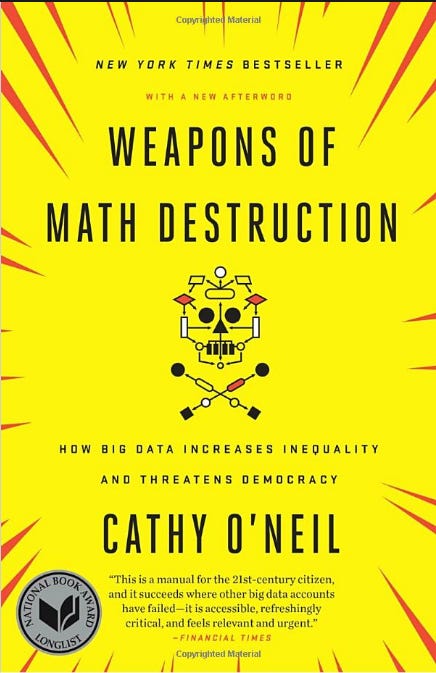
As an example, she talks about algorithms used to calculate a person’s likelihood of recidivism - the likelihood that someone convicted of a crime will reoffend. Most US states use an algorithm to calculate this, however, in some states it is used in inappropriate ways. Colorado and Idaho both use the algorithm to influence the judge’s sentencing. The questionnaire used to assess someone’s likelihood of recidivism (the LSI-R) has questions about the individual’s upbringing, their friends and family, their past interactions with police - much of which is information that would not be permissible to use as evidence in the individual’s trial - and then uses that + some math magic to give them a score. This score then influences the severity of the person’s sentence.
We don’t know what sort of judgements are being made for sure because the algorithm is a black box we can’t see in to. We can’t see what sort of bias is present. Is the person from a low socioeconomic background? According to the algorithm, that makes them more likely to offend again. Now the LSI-R will recommend they be punished more harshly because of that, making it more difficult to get out of that poor financial situation, possibly pushing them back to crime and reinforcing the cycle of recidivism.
In many cases, the algorithm isn’t “predicting” recidivism, it’s promoting punishments and forcing environments on people that push people to commit crime again. Is it the person freely choosing to do this? Or is the algorithm influencing it? Some important questions to ask. O’Neil would make the argument that the algorithm is making the problem of recidivism worse for those who are already suffering the most, and that it needs to start being held accountable.
Further Reading on Models
Jason Collins, an economist who writes about the intersection of economics and evolutionary biology, wrote an article titled “We don’t have a hundred biases, we have the wrong model” in the newsletter “Works in Progress” In the article, he discusses why our current rational actor economic model doesn’t represent reality and how it can be improved.
Scott E. Page, a social scientist and professor at the University of Michigan, wrote The Model Thinker, where he discusses the importance of knowing many models and then teaches you those models in a surprisingly accessible way - Page held my hand and I made it through each statistical model with minimal tears.
Interesting Newsbits
While the drought being experienced across the globe is, well…bad, it has revealed some fascinating pieces of history. Across the world, dinosaur prints, remnants of ancient civilizations, and other finds are popping up as river and lake water levels lower. Cool and all, but lets work to cover them all back up please.
The war in Ukraine just hit its 6 month mark on August 24th. Here’s a look at what the country has experienced.